

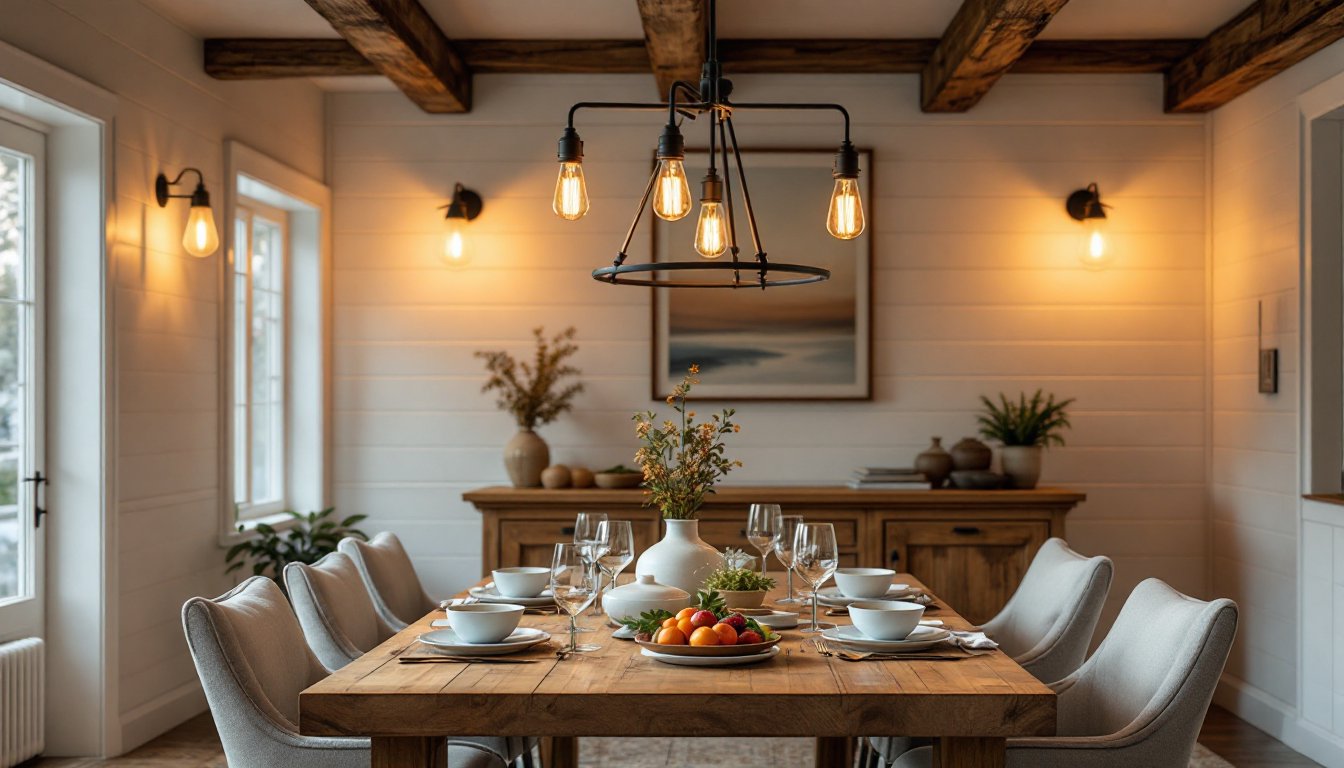

Joanna Gaines has made farmhouse design feel both accessible and aspirational. Her approach to dining room lighting strikes a balance between function and character, combining industrial bones with warm, inviting fixtures that anchor the room without screaming “décor.” If you’re drawn to her aesthetic but wondering how to apply it to your own space, this guide walks through the principles behind her lighting choices and shows you how to carry out them. Whether you’re rewiring an entire room or swapping out one key fixture, understanding her farmhouse philosophy makes the process straightforward.
Key Takeaways
- Joanna Gaines’ farmhouse dining room lighting philosophy emphasizes layering ambient, task, and accent light sources rather than relying on a single overhead fixture to create depth and mood flexibility.
- Pendant lights and chandeliers are essential to the aesthetic—choose fixtures with clean lines, blackened metal, and warm color temperatures (2700K–3000K) that complement your table and existing room materials.
- Proper fixture sizing and hanging height matter: select a chandelier or pendant 12 inches shorter than your table width and hang it 30–36 inches above the dining surface for clear sightlines.
- Wall sconces, under-shelf LED strips, and other accent lighting add visual interest and allow you to adjust the room’s atmosphere throughout the day without cluttering the space.
- Many farmhouse lighting upgrades like fixture swaps, dimmer installation, and LED strip additions are DIY-friendly projects, while circuit additions and major rewiring require a licensed electrician for code compliance.
- Installing dimmers on dining light circuits is one of the highest-impact, lowest-effort upgrades, transforming ambiance by adjusting brightness from 100% for family meals to 50% for intimate dinners.
The Hallmarks Of Joanna Gaines’ Farmhouse Design Philosophy
Joanna Gaines’ farmhouse aesthetic rests on a few core principles. First, she favors authenticity over perfection, exposed wood beams, vintage metal, and materials with visible wear tell a story. Second, function comes before decoration: every element earns its place. Third, she layers light sources rather than relying on a single overhead fixture, creating depth and mood flexibility.
In dining rooms specifically, this means mixing ambient, task, and accent lighting. A chandelier or pendant pulls double duty as sculptural statement and primary illumination. Wall sconces or a buffet light add depth without cluttering the ceiling. Edison-style bulbs, blackened metal fixtures, and shades in burlap or linen reinforce the raw, honest aesthetic she champions.
Her work on Fixer Upper and in spaces like the Magnolia House consistently shows restraint. She avoids overly ornate Victorian chandeliers or glitzy modern fixtures in favor of pieces that suggest industrial heritage, cast iron, brass accents, simple geometric forms. The result feels lived-in and real, not staged.
Essential Lighting Elements In Farmhouse Dining Rooms
A well-lit farmhouse dining room typically layers three types of lighting: ambient (overhead), task (focused), and accent (mood). Ambient light sets the general brightness level and comes from your chandelier or pendant fixture above the table. Task lighting supports dining and conversation, a lower-hanging pendant with a wider spread, or a dimmer switch, prevents shadows on faces and food. Accent lighting, like wall sconces or under-cabinet strips, adds visual interest and allows you to adjust mood throughout the day.
Farmhouse style particularly suits fixtures made from metal, wood, and natural materials. Think cast iron arms, wrought iron scrollwork, reclaimed wood bases, or exposed Edison bulbs. Warm color temperatures (2700K–3000K) keep the space inviting: cooler whites (4000K+) feel sterile against rustic elements.
Pendant Lights And Chandeliers
Pendants and chandeliers are the workhorses of farmhouse dining rooms. In Gaines’ designs, they typically feature clean lines, minimal ornamentation, and materials that whisper rather than shout. Wrought iron chandeliers with candle-style bulbs, large drum pendants in linen or aged-glass shades, or cage-style fixtures with visible Edison bulbs all fit the farmhouse language.
When sizing, the pendant or chandelier diameter should be 12 inches shorter than your table width. For a 36-inch-wide table, aim for a 24-inch fixture. Height matters too: hang the fixture 30 to 36 inches above the table surface, allowing clear sightlines for diners. If your ceiling is vaulted or over 9 feet, add 3 inches to the hanging distance per additional foot of height.
Installation requires turning off power at the breaker, removing the old fixture, and running new wire if needed. Most pendant or chandelier mounting brackets screw to an existing junction box or a new one installed by an electrician. If you’re not confident wiring a fixture, hiring a licensed electrician saves headaches and ensures code compliance (NEC Article 410 covers lighting fixture installation).
Wall Sconces And Accent Lighting
Wall sconces flank a dining room mirror, sideboard, or accent wall, adding asymmetrical visual weight and task light for eating or serving. Farmhouse sconces often feature blackened-brass arms, milk-glass shades, or open-frame designs that let the bulb serve as part of the décor. Pair them at roughly 60 to 66 inches from the floor, level with the center of any mirror or artwork nearby.
Accent lighting, perhaps under a floating buffet or along open shelving, reinforces the layered-light philosophy. LED strip lighting in warm white tones is economical and hides easily. A single wall-mounted reading lamp or table lamp on a sideboard adds warmth and practical illumination without visual bulk.
How To Select The Right Fixtures For Your Space
Choosing farmhouse lighting starts with your room’s existing bones. What’s your ceiling height? Is the dining table centered, or does your layout suggest an off-center pendant? What materials dominate, wood, stone, drywall? A fixture should complement, not fight, those anchors.
Scale matters. A tiny 8-inch pendant overwhelms a 12-by-14-foot room: a massive ornate chandelier crushes a compact breakfast nook. Measure your table, step back, and visualize proportions. Browse HGTV and interior design sites for dining rooms matching your space size and style.
Next, consider bulb type. Vintage Edison or decorative filament bulbs (40–60W equivalent, dimmable) suit fixtures where the bulb is visible. Enclosed shades call for standard A19 or BR30 bulbs in warm white (2700K). Dimmable LED bulbs are now affordable and dimmer-compatible, cutting energy use by 75% compared to incandescent without sacrificing warmth.
Finish choices, blackened metal, brass, oiled bronze, or painted wood, should echo other hardware in the room (cabinet pulls, faucet, light switches). Farmhouse style tolerates mixed metals well: a blackened-brass pendant with brass sconces reads cohesive rather than chaotic.
Budget ranges widely. A basic pendant fixture runs $40–$150, a statement chandelier $200–$800+, and wall sconces $50–$300 each. Premium farmhouse lighting from high-end retailers carries steeper tags, but mass-market and vintage-market options deliver authentic style affordably. Factor in installation labor if you’re hiring an electrician.
DIY Lighting Projects Inspired By Joanna Gaines
If you’re handy, several lighting upgrades fall within DIY reach, swapping fixtures, installing dimmer switches, or adding accent lights. A few things remain pro-only: adding circuits, running new wire in walls (usually requires permits), or major rewiring.
Fixture Replacement (DIY-friendly): Swapping a chandelier for a pendant over an existing junction box takes 30 minutes. Turn off power at the breaker, test with a non-contact voltage detector to confirm it’s off, remove the old fixture hardware, and mount the new bracket. Wire connections are simple: twist black to black, white to white, and ground (bare copper) to ground or to a green screw. Screw the canopy to hide the connections, and you’re done. This assumes the existing junction box, wiring, and bulb specs match your new fixture. When in doubt, have an electrician inspect before powering back on.
Dimmer Installation: Replacing a standard on-off switch with a dimmable switch lets you adjust pendant and sconce brightness, setting mood for dinner parties or weeknight eating. Turn off power, remove the existing switch plate and outlet, unscrew the switch, and disconnect the wires. Most dimmers accept the same wire configuration, just swap connections and screw the new dimmer into the box. This assumes standard 120-volt wiring and a single light circuit: 3-way switches or unusual layouts need professional help.
LED Strip Under Shelving: Adding warm-white LED strips under a open buffet or floating shelf is purely cosmetic and requires no wiring expertise. Measure the shelf length, buy adhesive-backed LED strip rated for kitchen/dining (3000K, 12V), clean the underside of the shelf with a damp cloth, and stick the strip on. Plug the transformer into a nearby outlet, and adjust brightness via remote. This project introduces mood lighting without structural changes.
Resources like YouTube and rustic chandeliers and farmhouse lighting styles show real-world installs and sourcing tips. Always prioritize safety: if you’re unsure about wiring or code compliance, call a licensed electrician.
Bringing Farmhouse Lighting Into Your Own Dining Room
Translating Joanna Gaines’ aesthetic to your dining room doesn’t require hiring a designer or a major renovation. Start by auditing your current lighting. Do you have a single overhead fixture? Switch to a layered approach: keep overhead ambient light, add dimmer control, and introduce wall sconces or accent strips for depth. This phased approach spreads cost and lets you test ideas before committing.
Second, visit antique shops, salvage yards, or online marketplaces (Facebook Marketplace, eBay, Etsy) for vintage fixtures. A reclaimed factory pendant or vintage schoolhouse sconce costs far less than new and carries genuine patina. Just confirm the fixture’s wiring is sound and electrician-approvable before installation.
Third, pair fixture choices with simple materials. If your table is wood, add a fixture with wood or metal accents. If your dining chairs have upholstered backs, echo that warmth in a linen pendant shade. Simplicity, avoiding fussy trim, excessive crystals, or novelty themes, keeps the space timeless and personal rather than a showroom replica.
Final tip: use dimmers on every dining light circuit. Dimming a chandelier from 100% brightness for family meals to 50% for intimate dinners costs little (a quality dimmer is $30–$60) and transforms ambiance instantly. It’s one of the highest-impact, lowest-effort upgrades for any dining space.
MyDomaine’s interior design guides and HGTV’s renovation gallery offer room-by-room inspiration to refine your vision before shopping.