

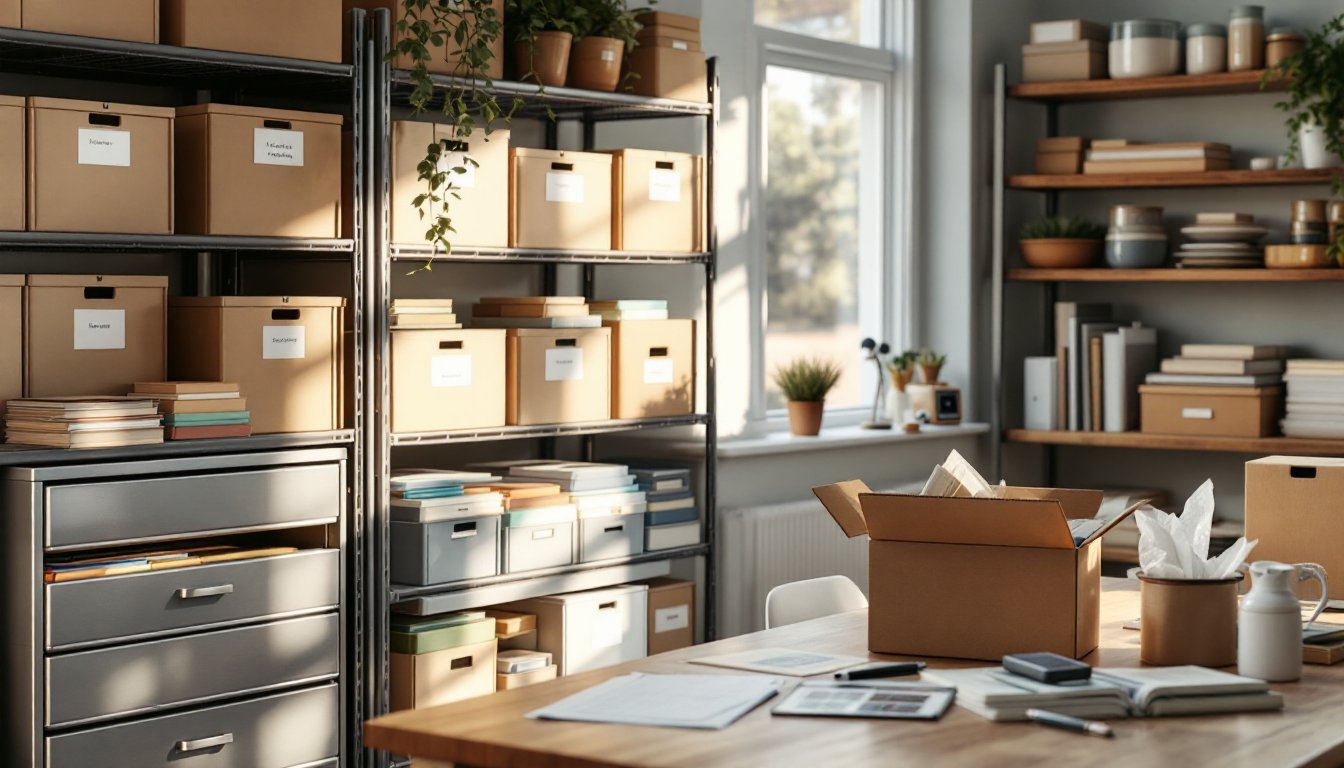

Files pile up fast. Tax returns, insurance documents, old family photos, warranties, and decades of sentimental keepsakes end up scattered across drawers, closets, and garage corners, vulnerable to damage, mold, and chaos. Without a solid archive storage system, homeowners waste time hunting for critical paperwork while risking loss of irreplaceable memories. Whether you’re preserving birth certificates and mortgage documents or protecting vintage photographs and heirloom videos, proper archive storage isn’t just about neatness. It’s about protecting your family’s history and ensuring you can actually find what you need when you need it.
Key Takeaways
- Archive storage solutions protect irreplaceable documents and memories from deterioration caused by sunlight, moisture, heat, and pests while freeing up valuable living space.
- Maintain stable storage conditions between 60–70°F and 30–40% humidity using dehumidifiers, sealed containers, and climate-controlled spaces to preserve documents and photographs long-term.
- Combine physical archives with high-quality digital backups—keep originals in archival-grade boxes or safety deposit boxes and store scanned copies on cloud services or external hard drives for redundancy.
- Organize your archive storage by purging outdated records, categorizing documents into logical buckets (Financial, Legal, Medical, Home & Property, Family & Personal), and labeling everything clearly with a master inventory.
- Use acid-free archive boxes, filing cabinets, and storage furniture placed in stable locations like closets or spare bedrooms—never basements, attics, or exterior walls prone to temperature and humidity fluctuations.
- A well-organized system with consistent labeling and color-coding lets you locate critical documents in seconds, while archival-quality materials ensure your family’s history survives decades intact.
Why Proper Archive Storage Matters For Homeowners
Archive storage isn’t a luxury, it’s damage control for your documents and memories. Paper deteriorates faster than most homeowners realize. Sunlight fades photographs within months, moisture encourages mold and mildew, heat warps documents, and pests chew through years of tax records. Beyond physical decay, disorganized archives create real problems: you can’t find your home’s original inspection report when the roof leaks, you dig through boxes to locate insurance paperwork after a claim, or you lose photos your kids will want someday.
Structured archive storage buys you peace of mind and protection. It keeps critical documents (deeds, contracts, warranties) in one secure, findable location. It preserves irreplaceable items (negatives, film, handwritten letters) from moisture, light, and temperature swings. And it frees up prime closet and shelf space you’d otherwise waste on chaos. The effort you invest upfront, sorting, labeling, and storing properly, saves hours of frustration later and ensures your family records survive decades intact.
Types Of Archive Storage Solutions To Consider
Archive storage comes in several forms, each suited to different needs and budgets.
Physical filing and storage remains essential for legal documents, original photographs, and anything you need quick access to. Lateral file cabinets (4-drawer models are standard) hold more than you’d expect and fit neatly in a study or bedroom. Metal filing cabinets resist moisture better than particleboard, though they’re heavier to move. Archive boxes, acid-free, lignin-free cardboard designed specifically for long-term storage, cost $5 to $15 each and stack efficiently on shelves or in closets. Unlike regular moving boxes, they won’t degrade your documents over time.
Shelving systems let you store and see your collection at a glance. Adjustable metal shelving units rated for heavier loads ($80–200 per unit) work well in basements, attics, or dedicated storage rooms. Wood shelves look nicer but can warp in humid environments unless sealed properly.
Climate-controlled storage addresses the biggest threat to archives: environmental fluctuation.
Climate-Controlled Storage And Environmental Protection
Temperature and humidity are your archives’ worst enemies. Professional archivists recommend storage between 60–70°F and 30–40% relative humidity. Basements fluctuate wildly (cold, damp winters: muggy summers). Attics swing even more (hot and dry, then humid). Unfinished spaces invite mold, pest damage, and warping.
If your home lacks stable conditions, consider a few fixes:
Humidity control: A dehumidifier (running year-round in basements or crawl spaces) keeps moisture below 50%. Desiccant packs or silica gel canisters work in smaller storage boxes.
Temperature buffering: Insulation matters. Wrap shelving units or archive boxes in acid-free tissue or kraft paper to create a small thermal barrier. Avoid plastic sheeting, which traps moisture against documents.
Sealed containers: Airtight storage bins ($15–40 each, in acid-free grades) let you control a microclimate. Place desiccant inside and you’ve created a stable pocket regardless of the room’s humidity.
For truly irreplaceable items, negatives, one-of-a-kind family photos, original letters, a safety deposit box at your bank provides professional climate control at roughly $100–200 yearly. Store duplicate copies or digital scans at home and originals in the vault.
Digital Vs. Physical Archives: Finding The Right Balance
The smartest approach uses both. Keep originals safe in a physical archive, maintain high-quality digital backups, and store critical documentation in multiple formats.
Digital archives prevent total loss. Scanning important documents (at 300 dpi minimum for photos, 200 dpi for text) creates searchable copies and frees shelf space. Cloud storage services, Google Drive, Dropbox, or OneDrive, cost $2–10 monthly and automatically back up files across data centers. External hard drives ($50–150) offer a second layer: store one at home and one in a safety deposit box or at a trusted friend’s house.
But, digital files aren’t permanent. Formats become obsolete (try opening a file from a 1990s CD), services shut down, passwords get lost, and hard drives fail silently. Plus, digital originals lack the legal weight of actual documents. A scanned deed helps you remember where to find the real one, but courts and agencies want the original.
Physical archives still matter for originals. Keep documents that prove ownership, identity, or inheritance (deeds, titles, birth certificates, wills) in their original form. Store irreplaceable photographs as physical prints in archival-quality sleeves, not just JPEG files. Handwritten family letters have emotional weight and historical value that pixels can’t replicate.
The practical balance: digitize everything for backup and searchability, but preserve originals for critical documents and treasured items. Your digital copy is a convenience: the physical original is your security blanket.
DIY Archive Organization Tips And Best Practices
Organization beats fancy equipment every time. A well-sorted pile in a cardboard box beats an expensive cabinet full of scrambled files.
Start by gathering everything. Pull documents from junk drawers, file folders, shoeboxes, and that envelope in the back of the closet. Lay it all out and you’ll see the scope of what you’re protecting.
Purge ruthlessly. You don’t need every credit card statement from 2010 or every utility bill ever received. Keep tax records for seven years (IRS standard), mortgage paperwork forever, medical records for seven years past the last visit, and warranties as long as you own the item. Everything else: shred it or recycle it. You’ll cut your storage needs in half.
Handle preservation properly. Never use staples, paperclips, or rubber bands on documents you plan to keep long-term, they rust, degrade, and damage the paper around them. Use acid-free folders and sleeves instead. Don’t use tape (it yellows and dries out): use acid-free glue sticks for repairs. Store photographs in archival sleeves, never in regular plastic albums that off-gas chemicals and degrade images.
Keep a master list. As you organize, photograph or photocopy your documents and create a simple spreadsheet: file name, location, date, and any notes. Store this list digitally and print a copy. It’s your roadmap to finding things fast.
Categorizing And Labeling For Easy Retrieval
Category structure matters more than perfection. Use broad buckets that make sense to you:
Financial (tax returns, mortgage documents, bank statements, investment records)
Legal (deeds, titles, marriage license, wills, insurance policies)
Medical (vaccination records, past prescriptions, surgical notes, dental records)
Home & Property (receipts for major repairs, HVAC maintenance logs, appliance manuals, warranties)
Family & Personal (birth certificates, passports, school records, photographs, family letters)
Within each category, use consistent labeling. A label maker and acid-free labels ($8–15) pay for themselves in time saved. Write clearly and include the year on financial or tax documents. Avoid cryptic abbreviations, “Tax-2023” beats “TX-23” every time.
Color-coding works too. Assign each category a tab color and you’ll grab the right file by sight. Recent research on home organization shows homeowners recall items faster when they’re color-coded compared to black-and-white labeling.
Number your boxes or shelves. If you keep multiple archive boxes, number them (Box 1, Box 2) and list what’s inside each one on a master inventory. Store that inventory with your master list. Now finding a 2019 home repair receipt takes seconds, not hours.
Choosing Storage Containers And Furniture For Archives
The right container protects your archives and fits your space.
Archive boxes (acid-free, lignin-free cardboard) are the gold standard for long-term storage. They cost $8–12 each and come in standard letter size (9″ × 12″ × 4″) or legal size (10″ × 15″ × 4″). Avoid regular moving boxes, which contain acid and will yellow your documents over time. Brands like Hollinger Metal Edge and Gaylord Archival are industry favorites, though supermarket craft brands now offer decent acid-free options.
Acid-free file folders and Mylar sleeves for photographs run $0.50–1.50 per item but pay dividends in preservation. Polyethylene terephthalate (PET) or polypropylene sleeves don’t degrade photographs like regular plastic does.
Storage furniture depends on your space and budget:
, Lateral filing cabinets (4-drawer, 52″H × 18″W × 28″D) fit standard file folders and cost $150–300. Metal versions resist moisture: choose one with ball-bearing slides if you’re opening and closing drawers daily.
, Shelving units work if you’re stacking archive boxes. A 5-tier adjustable metal unit (72″H × 48″W × 18″D) runs $80–150 and holds several hundred pounds of archives without sagging.
, Rolling carts ($40–80) let you move archives between rooms without straining your back.
Location matters as much as the container. Don’t store archives in basements prone to flooding, attics with temperature swings, or kitchens where steam and humidity reign. A closet, spare bedroom, or climate-controlled garage works best. Whatever space you choose, keep archives off the floor (moisture wicks up) and away from exterior walls where temperature fluctuates. Practical home organization strategies outlined at Real Simple often emphasize this same principle: location and containment prevent 80% of storage problems.